Saturday, April 28, 2007

Trans-Atlantic European Tax Law

Two interesting papers and a book recently published demonstrate a surge of interest across the Atlantic on the topic of European Tax Law.

EC Tax law is receiving increasing attention from the academia in the past years. The tax impact of the European Court of Justice (ECJ) judgments specially when dealing with the application of the fundamental freedoms have lead to numerous discussions, articles and books in the past years. One recent trend has been that the discussion forum has expanded geographically. A good example last year was that U.S. Law professors wrote one of the best papers on EC Tax Law (see Michael J Graetz and Warren, Alvin C "Income Tax Discrimination and the Political and Economic Integration of Europe" Yale Law Journal, Vol. 115, pp. 1186-1255, April 2006). In recent weeks I came across further contributions from the other side of the Atlantic which I must leave as suggestions.

In October 2005, a group of EU and US tax experts gathered at the University of Michigan Law School to discuss the different approaches taken by the ECJ and the U.S. Supreme Court to the question of fiscal federalism. The recent book Comparative Fiscal Federalism, Comparing the European Court of Justice and the US Supreme Court’s Tax Jurisprudence which is edited by Reuven S.Avi-Yonah, James Hines & Michael Lang will definitely further contribute to understand how those two systems or building blocs deal with different policy aspects.

In my last visit to Brazil, I came across authors interested in the tax sphere of the European economic integration, namely due to the development of the Mercosul. It is also not suprising that valuable contributions on the European topic come also from Brazil (e.g. Profs. Luís Eduardo Schoueri and Heleno Torres) and other South American countries.

Two papers provide further analysis to two sub-topics that are high in the agenda of European Tax Law. The first is the necessity and inherent difficulty to find a consistent line of the jurisprudence of the ECJ concerning the tax discrimination field. Te second paper addresses the hot topic of whether the fundamental freedoms of the EC Treaty encompass an absolute requirement on the Member States to mitigate double taxation, especially in view of the recent Kerckhaert & Morres case .

In first place Ruth Mason (University of Connecticut School of Law) has recently posted "IIn Search of Internal Consistency: Tax Discrimination in the EU“. Columbia Journal of Transnational Law, Vol. 46, 2007.

Here is the abstract:
The European Union was created to bind the countries of Europe together economically to prevent future wars. Rigorous enforcement of EU nationals' fundamental economic freedoms before the European Court of Justice (ECJ) has furthered economic integration. The fundamental freedoms prohibit tax discrimination—harsher tax treatment of cross-border economic activities than purely internal activities. Critics of the ECJ argue that the Court's broad interpretation of the EC freedoms causes it to find tax discrimination where there is none. This tendency encroaches upon the sovereignty of EU member states and hampers their ability to pursue economic policy goals. In contrast, based upon a survey of all the ECJ's tax discrimination decisions, this Article offers a more nuanced critique that shows the ECJ's errors in tax discrimination cases go in both directions. In addition to finding discrimination where there is none, the Court also sometimes fails to recognize discrimination. The Court's failure to recognize tax discrimination undermines the economic integration of Europe and abridges EU nationals' personal rights. This Article is the first to identify the Court's method of review in tax discrimination cases, the comparable internal situation test (CIST), as a principal contributor to the Court's difficulty in tax cases. Instead of CIST, the Article proposes that the ECJ borrow a method developed by the U.S. Supreme Court for tax cases arising under the Commerce Clause: the internal consistency test (ICT). Adoption of this simpler method should enable the ECJ to make more coherent tax decisions, which will promote economic efficiency and integration of the European common market.

Secondly, Georg Kofler (NYU) and Ruth Mason have jointly posted, "Double Taxation: A European 'Switch in Time'?“. Columbia Journal of European Law, Vol. 14, No. 1, 2008.

Here is the abstract:
This article considers whether the fundamental freedoms of the EC Treaty encompass an absolute requirement on the Member States to mitigate double taxation, and it concludes that such a requirement could reasonably be inferred from the goals of the fundamental freedoms and the European Court of Justice's double burden jurisprudence. Notwithstanding the reasonableness of that interpretation, in the recent Kerckhaert & Morres case, the Court of Justice found that the EC Treaty permits double juridical taxation, even though double taxation distorts the Internal Market. We review the history of the Court's relevant jurisprudence, consider alternative theories under which the Court could rule that double juridical taxation violates the EC Treaty, and compare the treatment of double state taxation in the United States by the Supreme Court under the dormant Commerce Clause.

Labels: ,

Friday, March 09, 2007

Please hold the line, the CCCTB will be with you shortly

The 2787th Economic and Financial Affairs (ECOFIN) Council meeting adopted a key issues paper to be submitted to the European Council on 8 and 9 March 2007, which outlines the main policy objectives relating to economy and finance. This meeting will probably stay in the annals of history not because of its round number (a think it is time they stop counting these meetings) or because what was said or discussed in terms of tax issues. The novelty is perhaps what is actually missing from the Key Issues Paper (KIP) prepared by the German Presidency, namely any reference to the ongoing project on a European-wide Common Consolidated Corporate Tax Base (CCCTB).

The draft KIP (which actually means chicken in my adopted Dutch language) originally included a heading on “tax policy in Europe – further development in the field of direct taxation”. There the actual CCTB project was apparently reaffirmed as a priority of the EU to further enhance the harmonization of direct taxation in Europe. Probably as a direct result of pressures from member states that do not favor the CCTB project (e.g. Latvia. Ireland, UK), the reference of CCTB as a key policy objective was (apparently) excluded from the final paper. An enigmatic point 3.3., under the heading “Tax policies in Europe – enhancing the internal market”, now addresses the tax issues:

National rules on taxation differ between Member States. The functioning of the internal market may be improved through co-operation on taxation among Member States and where appropriate at the European level, while respecting national competencies. The Council (Economic and Financial) has been informed of the ongoing work especially in the field of taxation and of action taken to tackle fiscal fraud and harmful tax practices.

It should be noted that the Commission's goal on the CCTB is to present a full community legislative proposal to the ECOFIN and to the European Parliament by the end of 2008. It is also public the resistance of some member states to any type of legislative proposal and the (open) possibility of the CCTB to proceed its path under the controversial enhanced cooperation procedure, which generally only requires eight member states. What is now uncertain is the consequences of an eventual setback at the level of the EU Council of the (German or Presidency) ideas to prioritize the CCTB project under the Lisbon agenda.

I have to admit that it has been difficult for various reasons to follow this project from the outset. A mixture of possibility that the project derails (as some other EU projects) and also too much information available (and no incentive to read) has made me avoid entering fully into this subject from a technical perspective. And it easy to understand why!

The CCCTB project, which the Commission officially launched in the autumn of 2004, has covered various technical meetings involving experts from all twenty seven Member States. The discussions have addressed several highly technical structural elements of the tax base, such as assets and tax depreciation, reserves, provisions and other additional elements such as group taxation, territorial scope or international aspects. Amongst the several meetings described in the EU Commision website, the following working documents have been discussed:

Working Document The mechanism for sharing the CCCTB
Working Document Related parties in the CCCTB
Working Document Issues related to business reorganisations
Working Document Personal Scope of the CCCTB
Working Document Dividends
Working Document Issues related to Group taxation
Working Document Administrative and Legal Framework
Working Document Tax treatment of Financial Institutions
Working Document Territorial Scope
Working Document International aspects in the CCCTB
Working Document Financial assets
Working Document Taxable income
Working Document Tax balance sheet
Working Document Capital Gains and Losses
Working Document Intangible Assets
Working Document Liabilities, Reserves and Provisions
Working Document General Tax Principles
Working Document Assets and Tax Depreciation

In addition to the numerous EU working documents, written contributions have been also received from third parties, with a particular reference to the very active BusinessEurope (formerly UNICE). Knowing that some member states have limited resources, I am not surprised that this project is giving some headaches to some tax officials.

In the end, even though the success of the most ambitious proposal of the Commission in the field of corporate taxation seems uncertain, I will continue to pay (as much as possible) attention to the CCTB project. Just in case…

PS: Perhaps some of you recognized, but what better than M. C. Escher to portray the dimensions and confusions of being a European?

Labels:

Wednesday, February 14, 2007

Switzerland: the EU pressure is mounting

Just a small note following my previous post on the Switzerland-EU relations, to mention that the European Commission has finally decided to go ahead with the case against certain favorable company tax regimes in Swiss Cantons, which are considered by the EU as a form of State aid incompatible with the 1972 Agreement between the EU and Switzerland.

Now it is a question of time to see if all EU member states agree on the "tactic" to apply in negotiations with Switzerland to put an end on tax measures, which the EU consider are resulting in a distortion of competition.

Although the 1972 agreement apparently allows the EU to take retaliatory measures, the press release indicates in its final paragraph a willingness to find a negotiated settlement with the Swiss authorities. Eventhough, note that to substantiate the decision taken against Switzerland the press release even evokes past actions against State aid taken for example against Austria in 1993 (back then EFTA country) on the basis of a corresponding provision. These cases basically involved the withdrawal of tariff concessions (retaliatory measure) but ended up being litigated in the ECJ. Let’s see the next chapters of this cat and mouse soap opera

Labels: ,

Wednesday, January 17, 2007

2007 Tax Agenda: What to expect from the usual suspects?

Will a new deal for a European constitution boost the possibility for further agreement concerning other EU wide-ranging tax project such as the common consolidated corporate tax base? Will the newly elected Democrat congress stall the Bush corporate tax reform projects? Will the OECD finally conclude its PE attribution project? Will the UN “wake up” in terms of international tax issues and become a larger player in the policy discussions?

Enough of open questions and let’s make a “tour de table” of some of the issues that are in the agenda and may receive fresh inputs during 2007. Personally, I have a feeling that 2007 will probably be a transitional year in terms of international and European tax issues and that more challenging and exciting times await us in 2008. But that does not mean that the developments are not expected from the prolific “usual suspects”, namely OECD, the EU Commission and the ECJ.

The OECD tax agenda
The winds and waves are always on the side of the ablest navigators.
By Edward Gibbon, The Decline and Fall of the Roman Empire


As usual, the agenda of the OECD is impressive and several topics are expected to see the green light. In the tax treaty topics, a good news is that the ongoing project on profit attribution to permanent establishments is finally close to an end. The OECD published in December 2006 the long expected new versions of Parts I, II and III of its Report on the Attribution of Profits to Permanent Establishments, along with a cover note containing an update on the status of that project. As to the announced necessary changes to the language of OECD Model Tax Convention and Commentaries, somewhere in 2007 appears to be the target of the OECD.

But the issues under discussion go well beyond profit attribution and include, dispute resolution, taxation of services, non-discrimination, collective vehicles, employment income and last but not least the place of effective management.

Dispute resolution in the framework of tax treaties (Art. 25 of the OECD Model) is one of the hot topics at the moment. The discussion draft "Proposals for Improving the Process for the Resolution of Tax Treaty Disputes", of 1 February 2006, examines the ways of improving the effectiveness of the mutual agreement procedure under Article 25 of the OECD Model, including the consideration of other dispute resolution techniques. The 2006 draft, proposes a system for the mandatory arbitration of tax disputes (new paragraph 5) between two treaty countries when the tax authorities of those countries have been unable to resolve those disputes within a two-year period. Strangely enough the recent protocol concluded between the US and Germany adopted a different arbitration approach than the one suggested by the OECD (the so-called baseball arbitration).

The application of tax treaties to services (Art. 7 of the OECD Model) is a new topic in the agenda. The recently disclosed discussion draft entitled “The Tax Treaty Treatment of Services” includes new paragraphs 42.11 to 42.45 to the Commentary on Art. 5 of the OECD Model. The new paragraphs address the appropriateness of the current provisions of the OECD Model to deal with the tax treatment of services, views (and policy reasons) of States that do not agree with the principle of exclusive residence taxation of services and finally a alternative paragraph for Art. 5 of the OECD Model that secures additional source taxation rights, in certain circumstances, with respect to services performed within the territory of the source State.

As regards, place of effective management as a tie-breaker rule (Art. 4 of the OECD Model), the discussion draft dates back already to May 2003. The OECD Model was already updated in 2005 but nothing was said about the OECD abandoning this topic. On the contrary, recent case-law from OECD countries may trigger an interest in having a fresher look at the topic (See UK Court of Appeal decision in Wood v. Holden (2006) STC 443 on the question of corporate management and control/residence). The 2003 draft develops the two alternative proposals to improve the place of effective management concept under Article 4 paragraph 3 of the Model Tax Convention. The first proposal seeks to refine the concept of “place of effective management” by expanding the Commentary explanations as to how the concept should be interpreted. The second proposal puts forward the tie-breaker rule for persons other than individuals to modify Article 4 paragraph 3 of the Model Tax Convention together with Commentary thereon. I would expect further discussion on the topic.

Another project, where a draft is available but no recent news was received on its status, is the OECD plans to revisit the scope of paragraph 2 of Article 15. The discussion draft "Proposed Clarification of the Scope of Paragraph 2 of Article 15 of the Model Tax Convention" of 5 April 2004, clarifies its application in situations when services are provided through “offshore” intermediaries by addressing the interpretation of the word “employer”, the distinction between employment and self-employment. The issue, touching upon a wide industry practice of hiring-out of labour, may have large impact and that may well explain that no further developments are available.

A release of a draft concerning the ongoing project of revising the non-discrimination article (Art. 24), may well prove to be one of the highlights of the year. Taking into account the developments in the EU and the fact that the OECD Commentaries on Art. 24 remain largely unchanged since 1977, it is expected that the project of re-examining the non-discrimination principle will probably focus on: (i) the application of Article 24 to various existing group relief concepts (e.g., consolidation, inter-corporate dividend exemptions, tax-free intra-group asset transfers); (ii) the application of Article 24 to branch level taxation; and (iii) the application of Article 24 to the thin capitalization concept, particularly its relationship to Article 9.

A far-reaching project, which recently received new impetus, is the one concerning the Taxation of Collective Investment Vehicles. After the CTPA roundtable (including tax authorities and tax specialists of the financial sector) met in Paris on 1-2 February 2006 to discuss a number of issues related to the application of tax treaties to collective investment, the OECD decided to form an informal consultative group. This group of government and private sector representatives, under the auspices of the OECD, will tackle the tax treaty issues raised by the large cross-border portfolio investments held through collective investment vehicles and global custodians. The project will examine both substantive issues and practical administrative issues related to the application of tax treaties to these investments.

But OECD is not only a synonym of work in the field of tax treaties. The OECD global tax agenda includes, amongst others, developments in the field of (i) Transfer Pricing (i.e. monitoring of the OECD Transfer Pricing Guidelines); (ii) Consumption Taxes/VAT (iii) Transparency and Information Exchange and (iv) Tax Policy. Basically it is a very wide range of issues.

The European hidden tax agenda
“Much good work is lost for the lack of a little more”
By Edward H. Harriman

The state of uncertainty in Europe is already commonplace and presidential manoeuvres in France, political changes in the UK, hard politics with Turkey and digestion problems related to the latest enlargement are probably bound to be decisive in maintaining that feeling in 2007. Europeans may expect in addition to sluggish economic growth, a new attempt to approve a new (redux) constitution, probably as an outcome of a downsizing EU summit sponsored by Germany. All this facts may have hardly any impact on the European tax agenda for 2007. Apart of the new push towards the Constitution, the development and breeding of new ideas in the tax area will continue to come from the two main players, i.e. EU Commission and from the ECJ.

As regards the first player, a special attention should be given to advances on the creation of a common consolidated corporate tax base (CCCTB) in the EU. The target is only to release a proposal is 2008, but it is expected that position making of the EU member states will become more visible during 2007. The Commission will in fact attempt to reach in 2007 a consensus agreement on a draft CCCTB project and for that will receive the additional support of the German EU presidency. The Commission will have to convince with the “carrot” some reluctant Member States (and even Commissioners such as the Irish Charlie McCreevy) that the best way forward is not to prolong tax competition amongst member states and adopt a common tax base. The “stick” to be used is the enhanced cooperation, which would allow one-third of EU Member States (9 out of 27) to adopt legislation that couldn't be passed unanimously.

However the CCCTB is hardly the remedy for the entire panacea, since there also continues to be a need for more targeted measures for short & medium term problems and for individual taxpayers. Hence, the need for better coordination of un-harmonised direct tax systems.

For this purposes, the new soft-law approach of the EU Commission is also expected to receive further developments. The end of 2006 saw the release of a set of Communications on a co-ordination of national direct tax systems, with a special emphasis on exit taxation and cross-border loss relief. The year of 2007 will probably be the year of the Commission communications ultimately directed to: (i) remove discrimination and double taxation; (ii) prevent inadvertent non-taxation and abuse; and (iii) reduce the compliance costs associated with cross-border investment.

In fact, the Commission considers a key topic that of the control of the application of specific Community tax provisions and of the Treaty freedoms. For that purposes, it plans, besides watching over the correct application of EU law by member states, to issue soft policy communications and guidelines designed to lead the member states to the desired result through coordination. This will probably be followed by benchmarks of best practices in several areas intended to pave the way for reform and alignment of domestic law with EC Tax principles. It would be no surprise if the Commission future work would focus on issues such as withholding taxes, group taxation, taxation of permanent establishments and anti-avoidance rules.

Other areas where inputs from the EU Commission are expected include, the ongoing project of the one stop shop in the area of VAT, the fight against tax fraud through the revamp of the mutual assistance directive and finally the area of environmental taxation (by means of ‘green taxes’, CO2 tax, vehicle taxes and tax incentives).

Finally, a topic where much development is expected in the near future is the area State Aid. The past year was marked in this area by new communications on the effective use of R&D tax incentives and the State Aid decision concerning the Luxembourg 1929 Holding regime. As regards 2006, the highlights will probably be the decision on the recent Dutch tax reform and the forthcoming decision of the Court of First Instance in the Gibraltar case, where the court will have the first opportunity to test the line of defence based on regional autonomy (see Azores case).

As regards the European Court of Justice, the last year has demonstrated that European Tax Law has maintained its importance. The key cases of the last year were definitely Marks & Spencer (cross-border losses), Cadbury Schweppes (CFC), Denkavit international (Outbound Dividends), Kerkhart & Morres (Relief for juridical double taxation), N case (Exit tax) Bouniach (withholding tax), Halifax (VAT Avoidance) and Banca Popolare de Cremona (IRAP). The year of 2007 will probably be the year of consolidation of the important jurisprudence issued in 2005 and 2006. It may also well be the year where the scope of the EC freedom of capital as regards third countries will be finally clarified (the non-tax case of Fidum Finanz set the grounds on 2006).

As regards the year to come, the ECJ continues to have an agenda rich of tax cases. Amongst the currently pending cases (some of them to be decided in 2007 or 2008), one may highlight the following:

(1) Meilicke (C-292/04). This case, which deals with the German corporation tax credit for foreign dividends, will give an opportunity to the Court to further develop the theory of the temporal limitation of the effects of judgments. The Advocate General suggested that the temporal effects of the judgment in Meilicke against Germany should not be limited.
(2) Thin Cap Group Litigation (C-524/04). This case deals with the UK thin cap provisions. The Advocate General already suggested that the UK thin capitalization regime is generally compatible with freedom of establishment.
(3) Skatteverket (S) v. A (C-101/05). This case deals with the Tax-neutral spin-off and the question submitted was whether a dividend distribution from a parent company, in the form of shares in its subsidiary located in a third state (with no exchange of information provision) should be tax exempt.
(4) Skatteverket (S) v. A and B (C-102/05). This case concerns the taxation of dividends distributed by close companies located in third countries, in this case Russia.
(5) Holböck (C-157/05). This case, which deals with free movement of capital and third countries, concerns an individual shareholder resident in Austria received higher taxed dividends from a corporation resident in Switzerland on which he held two thirds of the shares.
(6) Columbus Container Services BVBA (C-298/05). This case deals with the potential compatibility of a German treaty-override provision, which provides for a switch-over from the exemption method to the credit method in respect of low-taxed passive foreign permanent establishment (PE) income, with the basic freedoms under the EC Treaty.
(7) Amurta S.G.P.S. (C-379/05). This case concerns compatibility of the dividend withholding tax exemptions for non-resident companies with the EC freedom of establishment and free movement of capital (discrimination of outbound dividends) .
(8) Orange European Smallcup Fund NV (C-194/06), this case, in which no credit was given for Portuguese and German withholding taxes, deals with the question of whether the refusal to credit this tax infringed the freedom of capital movement.
(9) Cartesio (C-210/06). This case deals with on the scope of the freedom of establishment and its effect on national company laws, in particular, on the constraints imposed by this freedom on the regulation by the home and the host EU Member State of the transfer of seat of companies established under their national laws.
(10) Deutsche Shell GmbH (C-293/06). This case deals with the treatment of currency losses from the repatriation of start-up equity of PE.
(11) Heinrich Bauer Verlag (C-360/06), this case deals with different valuation of domestic and foreign participations.
(12) M+T (C-414/06). This case is one of the two pending ECJ two cases on the deductibility of losses of a foreign permanent establishment at the level of its parent which were rejected on the basis that the exemption method in the double tax treaties applied not only to positive but also to negative income. In this case, the PE was situated in Luxembourg.
(13) SEW (C-415/06). This case is the second of the two pending ECJ two cases on the deductibility of losses of a foreign permanent establishment at the level of its parent which were rejected on the basis that the exemption method in the double tax treaties applied not only to positive but also to negative income. In this case, the PE was situated in the US.
(14) Gronfeldt (C-436/06). This case deals with different thresholds for capital gains from domestic and foreign participations.
(15) Hollmann (C-443/06). This case deals with the not application to non-residents of the reduced tax base (50%) for capital gains.

Labels: ,

Thursday, January 11, 2007

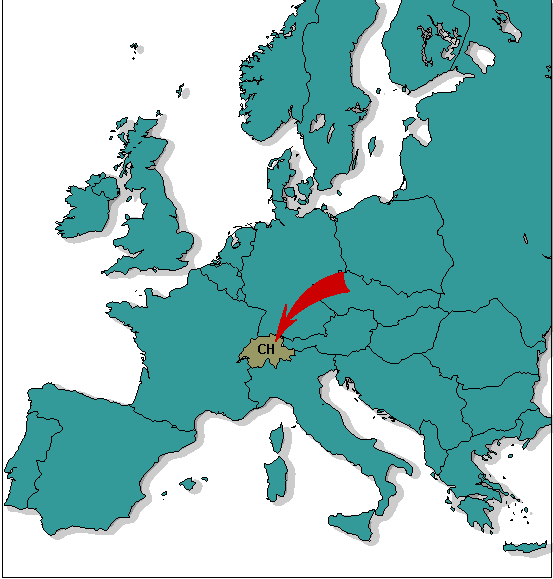
Is Switzerland under enough pressure from Europe institutions to clamp tax competition?

It is needless to say that international tax competition has become more intense as globalisation makes the world flatter. Switzerland is strategically centrally located in the hart of Europe and therefore in a privileged situation to attract foreign investment. A strong open economy, sacrosanct banking secrecy and a favourable tax system for multinationals have long made Switzerland amongst multinationals favourite headquarter locations.

As an example, the UK Times recently reported that Kraft Foods, the American multinational, recently announced that it is moving their European headquarters to Switzerland in search of efficient transport, lower taxes and an easier lifestyle.

The Swiss Federation, which includes 26 sovereign Cantons and approximately 2,900 independent municipalities, has a particular fiscally decentralised model for European standards. According to the Swiss Constitution, the Cantons have fiscal sovereignty and full right of taxation, except for particular sources that are allocated to the federal government. Basically, the Confederation (federal level) and the Cantons effectively share tax law making power for direct taxes on income and wealth.

Taking into account this decentralised model, the tax burden of a company may vary significantly depending on its Canton of residence. With a federal income tax levied at a flat rate of 8.5%, the effective income tax rate on profits for federal, cantonal, and communal taxes may be said to range between 13% and 30%, depending on the company’s place of residence. Nevertheless, at Cantonal level several tax incentives are available for example to newly established companies or holding, management and mixed companies. These incentives, which are ultimately designed to attract foreign investment, are an example of tax benefits available for multinational companies interested in locating their business in Switzerland.

The lowest corporate income tax rate in Switzerland is found in the business-friendly Cantons of Obwalden and Zug, where the effective income tax rate, including federal tax, is 13.1% and 16.44% respectively.

For much of the last decades, Switzerland has ranked amongst the wealthiest countries in Europe and recent studies have shown a boost of its international competitiveness. Low corporate tax rates, local tax incentives, favourable tax treaty network and recent access to EU free of withholding repatriation routes are amongst the main (tax) factors that explain the success of Switzerland in the international tax arena. Between international tax practitioners, Switzerland has become not only a favourable location for headquarters and holding structures, but also for finance and treasury activities (e.g. Swiss financing branches), commissioner and trading structures and last but not least a location for intellectual property and licensing activities.

The rise of Switzerland, just in the doorstep of Europe, as a favourable tax location has ignited again the tax competition debate. It is interesting to note that, both the OECD (which Switzerland is a member) and the European Union (with which Switzerland has several bilateral agreements) have been in the forefront of the discussion on tax competition.

It is important to recall that no longer than 10 years ago, OECD issued a groundbreaking report entitled, “Harmful Tax Competition: An Emerging Global Issue.” The project was based in three fronts: 1) identifying and eliminating harmful features of preferential tax regimes in OECD member countries 2) identifying “tax havens” and seeking their commitments to the principles of transparency and effective exchange of information and 3) encouraging other non-OECD economies to associate themselves with this work. As regards the first aspect, the 1998 report established a number of criteria for determining whether or not a preferential tax regime was harmful and included a commitment by the OECD Member countries to eliminate harmful tax regimes. The OECD work identified 47 preferential tax regimes as potentially harmful, out of which 19 regimes were, in the meantime, abolished, 14 amended to remove their potentially harmful features and 13 found not to be harmful on further analysis. In an annexed statement to the 1998 report, Switzerland (and Luxembourg) openly opposed the report.

In Europe, tax competition between member states has also been an issue for more than a decade now. The EU is marked by a significant diversity of company tax systems and as pointed out by the Ruding Committee report (1992), that tax differences among Member States distort foreign location decisions of multinational firms, and cause distortions in competition, especially in mobile activities. Following the OECD, the EU permissive attitude ended with the adoption on 1997 of the EU Code of Conduct for Business Taxation. On that occasion, the European Commission also made a commitment to clarify the application of state aid rules in the field of business taxation, which resulted on the 1998 Notice on the Application of State Aid Rules in the Field of Business Taxation. The EU Commission went on to defend that all 66 regimes that fell within the scope of the EU Code of Conduct for Business Taxation and were listed as harmful tax measures, were susceptible to a state aid investigation. This twin-track approach (code of conduct and state aid rules) implied a departure from the European Commission's previous policy and provided immediate success tackling tax competition within the EU borders. The problem is that outside the borders tax competition continues to increase (e.g. Singapore and Hong Kong) and only now EU Member States appear to be committed to promote the standard of the Code of Conduct with third countries.

The issue with Switzerland, from a EU perspective, stems from the fact that low cantonal tax rates and selective tax incentives may be said to contravene Art. 23 of the 1972 EU-Swiss Free Trade Agreement (FTA). Article 23 of the FTA reads as follows:

The following are incompatible with the proper functioning of the agreement in so far as they may affect trade between the Community and Switzerland:
(...)
- any public aid which distorts or threatens to distort competition by favouring certain undertakings or the production of certain goods.
Should a contracting party consider that a given practice is incompatible with this article, it may take appropriate measures under the conditions and in accordance with the procedures laid down in article 27.


Taking into account this provision, the European Commission in December 2005 launched a consultation procedure with the Swiss Authorities, stating that Cantonal tax incentives granted to holding, management and mixed companies, are incompatible with the FTA and constituted a distorting state subsidy. The EU authorities also understand that such a case against Switzerland may also be substantiated under WTO and OECD rules.

The growing importance of tax competition as a factor to attract capital and business activity, the limits of the EU bilateral path with Switzerland and its already lasting suspicion of joining the EU may have been the igniters of this new diplomatic offensive. This consultation has naturally a political backdrop, since in some member States view it is hard to accept that Switzerland, which benefits under certain bilateral agreements from a privileged access to the EU internal market, maintains an aggressive tax policy with the clear objective of attracting European mobile activities.

Nevertheless, Switzerland is not a member of the EU and State Aid, as such, is an alien and somewhat difficult concept to integrate in the existing legal order between the EU and Switzerland. Switzerland has since the rejection of the EEA agreement in 1992, adopted a different approach towards the EU, based on the conclusion of bilateral agreements. The political stakes were even raised after recently Swiss voters (narrowly) approved in November 2006 to give one billion Swiss francs (630m euros) in aid to the 10 new members of the European Union. The contribution to the European cohesion was the price agreed to pay when the EU and Switzerland agreed in 2004 a second package of bilateral treaties covering the EU-Swiss relations. On the other hand, the recent 2005 agreement between the Swiss Confederation and the European Community on the taxation of savings has even helped to reinforce the competitiveness of Switzerland tax system, by granting measures equivalent to those found in the EC Parent-Subsidiary and Interest and Royalty Directives to Swiss entities receiving or paying such items of income (see Art. 15 of the Agreement).

In this context, it is rather natural that Switzerland counter argued that the EU couldn't impose (indirectly) its State Aid rules by simply interpreting the said Art. 23 of the FTA in similar way as it interprets and applies Art. 87 of the EC treaty. In a fairly complete reply to the European Commission memorandum, the Swiss Federal Tax Administration responded by arguing:
- Firstly, that the said tax incentives do not fall within the scope of the FTA, which itself only governs the trading of certain goods, and that Art. 23 does not provide a sufficient basis for an appreciation of corporate taxation in terms of competition law;
- Secondly, that Art. 23 is not to be interpreted in the same manner as the EC treaty’s state Aid rules; and
- Thirdly, assuming that cantonal tax regulations would fall within the scope of the FTA, that the relevant incentives would not constitute a incompatible state subsidy because: (i) they take into account the (less) use of infrastructures and are justified; (ii) they are not selective; and (iii) there is no interference with the bilateral movement of goods.

The Swiss tax authorities concluded by simply rejecting any responsibility as a participant in the EU internal market and reiterated that Switzerland only "seeks to offer an attractive location for making business by providing for a package of advantageous conditions, as do all states. Corporate taxation is an important factor for choosing locations and making investment decisions – but not the only one by any means". To that effect the authorities pointed out that under the OECD parameters their system cannot be considered harmful, that in the EU one also finds a wide variety of tax levels and finally that the tax disparities in Switzerland do not arise at the federal level but instead at a Cantonal level.

The current state of play is unclear. One can argue that the fact that Switzerland is not a full EU member gives it more freedom regarding tax competition. Nevertheless, both politically and economically, Europeans should question whether Switzerland is under enough pressure from Europe institutions to clamp tax competition?

PS: this was my 201st post!

Labels: ,

Thursday, December 14, 2006

WHAT IS CLEAR AND NOT SO CLEAR FROM DENKAVIT II?

With the exception of the Parent–Subsidiary Directive, there is no specific EC rules concerning dividend taxation. Therefore, it is reasonable to say that dividend taxation falls under the competence of each of the EU Member States, subject to the increasingly important limits under the fundamental freedoms established in the EC Treaty. As we have seen throughout the extensive case-law of the ECJ in the field of direct taxation, EC law impacts on national tax systems as a result of the combined application of the four freedoms and the prohibition of discrimination and discriminatory restrictions.

The decision of the ECJ in the Denkavit II case (C-170/05), which held that the French withholding tax on outbound dividends is incompatible with the freedom of establishment (Art. 43 of the EC Treaty), is a good example of those limits. Under certain tax systems, outbound taxation of dividends was sometimes distinguished from domestic situations, where dividends were paid and receive by resident entities. In the first case, a domestic withholding tax was levied, while in the later case no withholding tax was levied (in order to prevent for example the cascading of tax through chains of companies). This case simply says that in a EU scenario such distinction may prove to be incompatible with the treaty freedoms.

Dividend taxation under international tax law

The structure of the international income tax, drawn from the so-called international consensus, is based on the assumption that income tax is generally levied (i) on the domestic and foreign income of its residents (residence taxation) and (ii) the domestic income of non-residents (source taxation). Under such system, whilst the residence concept establishes a relationship between a particular jurisdiction and the taxpayer deriving the income, the source concept connects the income itself with a particular jurisdiction.

Under that framework, when considering the taxation of dividends it is then important to distinguish: (i) a withholding tax levied on the dividends paid by the company on behalf of the shareholder at the moment the dividends are paid out; (ii) the taxation at the level of the shareholder receiving the dividends.

Under international income tax law, dividends are usually sourced on the basis of the residence of the company paying them. As such, if a resident of one country earns dividend income from a source in another country, double taxation is likely to arise because one country will tax that income on a source basis (usually through a flat-rate final withholding tax on the gross amount of the dividends) and the other country on a residence basis (usually using a progressive income tax rate scale for individuals or a flat-rate for companies).

In this case, the internationally accepted regime is that the source country has the prior right to tax (although limited by reduced treaty rates), and the residence country is responsible for relieving any double taxation that results. Such relief is generally achieved through the exemption system (whereby the foreign income is exempted from tax in the residence country) or the foreign tax credit system (whereby the tax of the residence country on the foreign income is reduced by the amount of source country tax on the income). Under that model, this case has to be distinguished especially from the so-called economic double taxation, i.e. where two different persons are taxable in respect of the same income or capital.

The domestic withholding tax rate on outbound dividends is typically set between 20%-30%, which is then generally reduced to 5%-15% under the respective tax treaties. A usual feature found in outbound dividend taxation relates to the distinction between direct investment (an investor which has a controlling shareholding) and portfolio investment (where no controlling shareholding exists). This distinction is generally defined through an ownership percentage of the capital (for example the OECD Model uses a 25% ownership test).

It should be noted that in respect of inter-company dividends, many countries have chosen recently in their tax treaties to simply eliminate its dividend withholding tax. This situation is related with the wider trend of lowering corporate income tax rates, inclusion of domestic exemptions on certain outbound payments and the enactment of the Parent-Subsidiary Directive, which was recently extended to Switzerland. Nevertheless, at this stage one can say that withholding tax on outbound dividends is still the rule under treaties. The issue now is to see how the same issue is covered under the EC Law framework.

Outbound dividends in Europe - An (in)complete framework

The area of dividend taxation in Europe, in addition to the bilateral treaties, is fundamentally marked by the existence of a EU directive for the taxation of parent and subsidiary companies. The so-called Parent-subsidiary Directive (Council Directive 90/435/EEC) had an immediate effect on cross-border business transactions in Europe, by providing a comprehensive double tax relief throughout Europe for dividends flowing between companies from different Member States when the companies are in a parent/subsidiary relationship.

The Directive, which deals with issues that were previously the exclusive concern of tax treaties, basically requires that Member States: (i) refrain from imposing withholding taxes on distributions of profits made by subsidiary companies to their parent companies in other Member States; and (ii) to grant parent companies double taxation relief in respect of such income either by exempting it from further tax or by granting relief for the underlying company tax on the profits out of which the distribution is made.

Nevertheless, the scope of the Directive seems narrower (on the first element noted above) than the Dividend article found in tax treaties, since its application is limited to certain types of companies established in accordance with domestic law of the EU member states. Even though there have been recent extensions of its scope, there is a range of situations outside the coverage of the Parent/subsidiary Directive that may need to be assessed applying the fundamental freedoms case law.

Just imagine the treatment of EU inter-corporate dividends paid by a company that does not meet the requirements set out in Art. 2 of the Parent-Subsidiary Directive. For example it may be a dividend paid by a type of company that is not listed in the Annex. In addition, just imagine a payment of inter-company dividends that fails the 20% threshold requirements of Art. 3. On a more extreme scenario, just consider individuals, which are not covered by the Parent-Subsidiary Directive and therefore are required to incorporate their holdings, through a "listed" company, to achieve the same objectives of source taxation minimization.

What happens in these ""fringe" cases? Is the Member State authorized per se to withhold tax in those situations (or not provide relief) or do we have to read these "fringe" cases in conjunction with ECJ case-law on discrimination? But then comes along a French case on inter-corporate dividends, which fortunately covered taxable years when the Parent-Subsidiary Directive was still not in place.

The Denkavit II Decision

This case involved a dividend distribution from an (almost) fully owned French subsidiary to its Dutch parent company, Denkavit International BV. The problem derived from the fact that domestic dividends were not subject to withholding tax and were 95% exempt at the level of a French parent company, whilst, dividends distributed to a foreign parent were subject to a 25% withholding tax. This domestic withholding tax was nevertheless reduced to 5% under the French–Dutch tax treaty. Since, Denkavit International BV was unable to credit the 5% withholding tax because its dividend income was tax exempt under the Dutch participation exemption regime, it decided to claim a refund of that withholding tax on the basis that a EU parent company could not be treated less favourably than a French parent company.

The ECJ basically followed Advocate General Geelhoed opinion and held that France is precluded under EC Law to impose a withholding tax on dividends paid to a non-resident parent company if it provides an (almost full) exemption of dividend withholding tax to French resident parent companies. In addition, the ECJ held that the dividend withholding tax is prohibited, even if a tax treaty between the Source and Residence State provides for the Residence State taxation to be set off against the Source State withholding tax, if the parent company is unable to set off tax in the residence State, in the manner provided for by the tax treaty.

In taking this decision, the ECJ first pointed out that since the case related to years where the Parent-Subsidiary Directive did not apply, only the relevant provisions of the EC Treaty should be taken into account.

In a rather short decision, the ECJ arrived quickly to the conclusion that the French tax system, irrespective of the effect of the relevant tax treaty, gave rise to a difference in the tax treatment of dividends paid by a resident subsidiary (no withholding tax on domestic dividends and 25% withholding tax on outbound dividends) and that such difference constitutes in principle a prohibited restriction on the freedom of establishment.

The ECJ rejected therefore the French arguments based on the non-comparability between a domestic parent and a EU parent and the justification based on the territoriality principle (which was apparently ignored by the ECJ).

As to the controversial comparability aspect, the ECJ referred that as soon as France, either unilaterally or by way of a treaty, imposes tax on the dividend income, not only of resident shareholders, but also of non-resident shareholders, from dividends which they receive from a resident company, the situation of those non-resident shareholders (which have or not a fixed place of business in France) becomes comparable to that of resident shareholders.

The ECJ on paragraph 37 of the decision followed the preposition of the Advocate General and held that since the domestic exemption on dividends is designed to avoid economic double taxation, France is therefore required to extend such a relief (i.e. exemption) also to non-residents, to the extent that similar domestic double economic taxation results from the exercise of its tax jurisdiction over these non-residents. (1)

(1) According to the Advocate General, this follows from the principle that tax benefits granted by the source State to non-residents should equal those granted to residents in so far as the source State otherwise exercises equal tax jurisdiction over both groups.

The ECJ went on to state that the heavier tax burden on dividends paid to Netherlands parent companies (as compared to dividends paid to French parent companies) constitutes a discriminatory measure incompatible with the EC Treaty. In conclusion, France should not levy a withholding tax on outbound dividends.

The second part of the judgment concerned the equally controversial issue of the effects of tax treaties on the compatibility of domestic law with EC law. The issue here was whether a different answer should be given if a tax treaty exists between the source state and the resident state, whereby a parent company resident in the resident state may offset the withholding tax levied in the Source State, but because of the resident State tax system (i.e. participation exemption) such parent company is simply unable to set off the respective withholding tax. In fact, the Dutch participation regime simply prevented the possibility of offsetting the French withholding tax against Dutch corporate income tax, resulting in an excess tax credit of 5%.

The ECJ was again short in its argumentation and held that in such a case, the combined application of treaty and Residence State participation exemption rules does not serve to overcome the effects of the restriction on freedom of establishment and therefore constitutes incompatible discrimination against foreign parent companies. In reaching its decision, the ECJ rejected the French argumentation that under international tax law it is for the Residence State and not for the Source State, in which the taxed income has its source, to rectify the effects of double taxation.

What is (not so) clear from Denkavit II?

The Advocate General Geelhoed intellectual construction, which distinguishes between home and source State obligations, appears to have been accepted by the ECJ. This means that the obligation of the Source State only arises insofar as it exercises its tax jurisdiction over the non-residents. In this case, the source State cannot discriminate between resident and non-resident taxpayers. On Denkavit II, the ECJ appears to oblige the Source State (France) to extend a relief for economic double taxation to the non-resident (Netherlands) equivalent to the relief given in the Source State. But is this case applicable on other types of income?

The particular features of this case appear also to point out that it only applies in circumstances where the Residence State is an exemption country. This link (between the exemption method and the outcome) although not entirely clear may be extracted from paragraph 54, which refers to the combined application of the tax treaty and the relevant domestic legislation (which in that case “does not serve to overcome the effects of the restriction on freedom of establishment”). Is this sufficient to rule out a case under the credit method?

First question: Does the ECJ mean that the case is only applicable to dividend withholding tax situations such as the one found in France-Netherlands? What if the residence state operates through a credit method? What about withholding tax on other types of income?

Another problem, left untouched, is that by doing so (i.e. extending the relief), the Netherlands parent company is slightly better of than a "comparable" French resident company. This is the case, since the exemption in France covers only 95% of the dividend income, whilst the Dutch participation exemption covers the full dividend income (100%). In limit, this should not prevent France to levy a least a withholding tax on the difference (33% of 5%= 1.65).

Second question: Is France then still allowed to tax this residual amount? If yes, at which rate? Treaty rate or CIT rate?

It is needless to say that this decision will have also an impact on Member States that apply a participation exemption regime for domestic parent companies, while applying a withholding tax on outbound dividends paid to EU parent companies, namely when the conditions for exemption under the Parent-Subsidiary Directive are not met. Just imagine, as is the case in various EU member states, that that holding thresholds for the domestic participation exemption and Parent-Subsidiary Directive differ. Nevertheless, governments may easily correct this difference by simply adjusting (upwards) the domestic thresholds or (downwards) the outbound thresholds. The problem here is that experience has shown that the adjustments made as a consequence of ECJ case law have in many instances worsened the position of domestic taxpayers. For example the legislative reaction to the Lankhorst Hohorst case (C-324/00), which found the German rules on thin capitalization in violation of the Treaty, resulted in some cases on the extension of thin-cap rules to domestic creditors.

Third Question: how will governments react to Denkavit II?

Another issue will be, whether such a case would be decided in the same way for portfolio participations that fall under the scope of free movement of capital (Art. 56 EC). The existing ECJ case law seems already to indicate that the same conclusion may be drawn. And what if we are in a third-country scenario? And what if the residence state has a credit system and there is an apparent cash-flow disadvantage on having a withholding tax on the outbound dividend and only later a credit? Here the pending Amurta case (C-379/05) will probably provide an answer in that respect.(2)

(2) The Amurta case, which also focuses on the compatibility of withholding tax on intercompany dividend, deals with the specific case where a company (resident in Portugal) owning 14% of the shares of a Dutch company, receives a dividend from which 25% Dutch withholding tax was withheld. Amurta filed an objection against the levy of withholding tax and argued that such levy violated the free movement of capital as included in Art. 56 of the EC Treaty, arguing that, had the company been resident in the Netherlands, no dividend withholding tax would have been due (based upon the participation exemption rules).

Fourth Question: can we apply the same line of reasoning of Denkavit to cases falling under the free movement of capital? Again, what if the residence state is a credit country and not an exemption?

The ECJ apparently ignored or diplomatically avoided to touch upon the controversial position used by former Advocate General Geelhoed, which distinguishes between “true” and “quasi” restrictions, whereby the latter restrictions fall outside the scope of the Treaty and therefore should only be eliminated by legislative action.(3)

(3) Using the words of the former Advocate General Geelhoed, "Quasi-restrictions result directly and inevitably from the juxtaposition of systems and in particular from: (1) the existence of cumulative administrative compliance burdens for companies active cross-border; (2) the existence of disparities between national tax systems; and (3) the necessity to divide tax jurisdiction, meaning the dislocation of the base."

Fifth Question: does this mean that the distinction between “true” and “quasi” restrictions is still hanging in the air?

In the end, litigation in this area will result in the necessity of symmetry between thresholds of participation exemption. In that regard, another area now left open by this case is its impact on "fringe" cases that fall outside the directive, such as dividends paid by type of companies that are not listed in the Annex of the parent-subsidiary Directive. This discussion of course raises the issue of the relationship between primary (EC Treaty) and secondary Community law (Directives), which is far from clear. One can say, that even if a certain area has been harmonized through a Directive, this does not entail the creation of an invulnerable domain, immune from the influence of the fundamental principles set out by the EC Treaty.

Sixth Question: can we apply the same line of reasoning of Denkavit II to cases outside the subjective scope of the Parent-Subsidiary Directive?

And what about individuals? Is it another ball game altogether as some say or can we also apply the same principles? As the EU Commission rightly puts it in the communication "Dividend taxation of individuals in the Internal Market (COM (2003) 810), "a Member State cannot levy tax a withholding tax on outbound dividends and exempt domestic dividends, as it would tax outbound dividends higher than domestic dividends." Nevertheless, the Commission also alerted to the fact that in assessing the higher burden, a simple comparison of the withholding tax rates is not sufficient. In fact, the basis of comparison should be for the domestic dividends the combined effect of any domestic withholding tax rate plus the domestic income taxation and for the outbound dividend the withholding tax rate on the outbound dividend. Looking at the existing case-law of the ECJ, which has mainly focused on inbound dividends, also here some doubts start popping!

Seventh Question: what about individuals? Is it another ball game altogether?


Any other questions?

Labels:

Tuesday, October 10, 2006

Index on European tax law research (revised version)

European tax law has immense research opportunities. As Professor Pistone said recently “European tax law is picking up” and therefore keeping up to date with this new promising tax area is a challenge even for the so-called EU specialist. This overview is designed to be a short index on EC Tax Law information available through various websites of the European Union's institutions and specialized agencies in Europe and provide you a useful tool to navigate in the cyberspace in a time effective manner.
Brief Historical background (with links)

Although there is no explicit provision in the EC Treaty for the harmonisation of direct taxes, EU actions on the filed of tax have been generally based on Art. 94, which authorises "directives for the approximation of such laws, regulations or administrative provisions of Member States as directly affect the establishment or functioning of the common market".

The concrete proposals for harmonisation of corporation tax started off with the Neumark Report of 1962 and the van den Tempel Report of 1970. In 1975, an unsuccessful draft Directive proposed an alignment of rates between 45% and 55% and by 1980 a Report on the Scope for Convergence of Tax Systems by Commission was already arguing that a different approach.

The 1990 Commission report Guidelines for Company Taxation explained how the Commission decided to focus on rather targeted measures essential for completing the Single Market. As such three proposals received the approval, namely the merger directive, the parent-subsidiary directive and the arbitration procedure Convention. In a special issue of the Official Journal, the commission published the report “Removal of Tax Obstacles to the Cross-frontier Activities of Companies” (Scrivener Report), were the Commission explained the measures and presented two additional proposals regarding: losses of permanent establishments and subsidiaries situated in other Member States and a common system for interest and royalty payments.

In 1992, the Ruding Committee reported on the Community aspects of company taxation and concluded that, although there has been some degree of fiscal convergence, wide differences, remain, which could affect or distort the single market. The Committee proposed a minimum degree of harmonization and gave 21 recommendations covering three categories: elimination of double taxation of cross-border income flows, harmonization of corporation taxes, and greater transparency between Member States on other issues. The Commission reacted by not agreeing with most off the proposals (namely the corporate tax harmonization) and focus again its attention on enlarging the scope of the merger and parent/subsidiaries Directives and bringing into light the interest & royalty Directive.

A 1996 paper on "Taxation in the European Union" outlined the main challenges for taxation policy in the Union and on 1997, the Ecofin Council reached agreement on a package of proposals designed to tackle harmful tax competition. In 1999, the Code of Conduct group on business taxation (established further to the ECOFIN conclusions of 1997) submitted its final assessment report, made public in 2000. In 2003, the interest and royalty directive went ahead. The savings Directive (ensuring a minimum of effective taxation of savings income in the form of interest payments) also was finalised. another major development was the 2004 EU Savings agreement between the European Union and Switzerland, which provides for the application of the Interest and Royalties Directive and the Parent-Subsidiary Directive in the relation between the European Union and Switzerland.

As a result, of the 2001 Commission Study, Company Taxation in the Internal Market and accompanying Communication, a long term strategy was mentioned for providing companies with a consolidated corporate tax base for their EU-wide activities. This project is advancing and several reports have been in the meantime made available. Another recent development was based on the work of the EU Joint Transfer Pricing Forum, which resulted Code of Conduct on transfer pricing documentation for associated enterprises in the European Union and the Code of Conduct for the effective implementation of the Arbitration Convention

It should be noted that although network of bilateral tax treaties still lie outside the framework of Community law, the Commission is considering the possible conflicts between the EC Treaty and the bilateral double taxation treaties that Member States have concluded with each other and with third countries.

In addition to the policy and legislative developments highlighted above, the development of European tax law has a very important judicial component since the European Court of Justice has been archiving harmonisation through the application of the non-discriminatory principles of the four fundamental freedoms. This effect is evident in the Court Cases in the field of Direct Taxation since the Avoir Fiscal (1986) to the more recent N case (2006).

General Information Links

EU Legislation on Taxation (as of 1.9.2005)
- This very useful document links you to all the legislation in force in the European union in the area of taxation

Direct Taxation Directives
- This document links you to the Direct Taxation Directives: namely the Merger, Parent-subsidiary, Interest and Royalties and Savings Directives.

Indirect Taxation Directives
- This document links you to the several Indirect Taxation Directives, with a particular reference to the Sixth Directive on VAT.

Company Law Directives
- This document links you to the several Company Law Directives currently in place

Treaty establishing the European Community
- This document contains the consolidated version of the Treaty of Rome.


Other Treaties or basic legal texts of the European Union
- This document contains links to remaining treaty texts.

Specific Links of Interest

Taxation and Customs Website

Commission Staff Working Paper - Company Taxation in the Internal Market - SEC(2001) 1681 An Internal Market without company tax obstacles: achievements, ongoing initiatives and remaining challenges - COM (2003) 726

Dividend taxation of individuals in the Internal Market - COM (2003) 810

Code of Conduct on Business Taxation (Primarolo report)

OECD Harmful Tax Practices report (1998) and the 2004 Progress Report DG Competition website (in-charge for State Aid procedure)

Report on the application of the state aid rules to measures relating to direct business taxation (2004)

State Aid Register - Commission Decisions

Court Cases in the field of Direct Taxation (updated as September 2005)

Search form for Judgments, Opinions and orders of the European Court of Justice

Case-law by numerical access from (i) 1953 to 1988 and (ii) since 1989

Daily Official Journal of the European Union

ECOFIN - Economic and Financial Affairs

Latest press releases from EU EU Member States Links

Keeping up to date with the news

Financial Times - Brussels briefing

PwC EU direct tax newsalerts

E&Y EU Tax Library

KPMG European Tax Centre

Loyens & Loeff EU tax alert

Baker & McKenzie European Tax Newsletter

Reference Books (Recent publications)

§ Ben Terra & Peter Wattel, European Tax Law; 4rd edition 2004, Kluwer Law international
§ Paul Farmer and Richard Lyal, EC Tax Law, 2nd edition, Oxford, To be Published: April 2006
§ Carlo Pinto, Tax Competition and EU Law (Eucotax), Kluwer Law International, 2003
§ Pasquale Pistone, The Impact of Community Law on Tax Treaties: Issues and Solutions (Eucotax Series), (Eucotax), Kluwer Law International, 2002
§ Servaas van Thiel, Free Movement of Persons and Income Tax Law: The European Court in Search of Principles, IBFD Doctoral Series, 2002

Relevant Tax Journals

European Taxation & VAT Monitor (IBFD)
Intertax & EC Tax Review (Kluwer)
Tax Planning International European Union Focus (BNA)
EC Tax Journal (Key Haven Publications)
British Tax Review (Sweet & Maxwell)

Labels:

Sunday, September 10, 2006

Regional selectivity: A fine day of sun for the European “true” autonomies

It is not every day (on the contrary) that Portugal is on the spotlight of the European Court of Justice (ECJ). In the first day after its summer vacations, the European Court of Justice issued a decision concerning the action brought by the Portuguese Republic seeking the annulment of Commission Decision 2003/442/EC which classified as state aid the reductions on the rate of income tax for natural and legal persons having their tax residence in the Portuguese Autonomous Region of the Azores (case C-88/03).(1)

(1) A region is the layer of government directly below the national level. The term is used, especially, in relation to regions with some sort of historical claim or idiosyncrasy in relation to the remaining territory. Examples may include for instance: (i) Scotland, Wales and Northern Ireland, in the UK; (ii) The island-regions of Sardinia and Sicily in Italy; (iii) the Basque country in Spain; or (iv) the Finnish province of Åland. Many other regions exist, with different degrees of decentralisation.

One interesting point is that the Azores case may be of great assistance to other autonomous jurisdictions within the European Union, such as Gibraltar and the Spanish Basque region, in their efforts to reform their tax systems and deviate from their central government tax system. In that regard, it should be mentioned that there is case currently pending in the European Court of First Instance (CFI) contesting the Commission decision regarding to the Government of Gibraltar’s’ plans for corporate tax reform.

The Azores tax benefits

The facts of the case are quite long and for persons not fully involved in state aid maters, this subject may seam a bit wearisome. But for sake of completeness allow me to very briefly explain what is state aid in plain tax terms and why is it important in the framework of the European Union internal market.

In 2000, the Portuguese authorities notified (as required by EC Law) the European Commission of a scheme adapting the national tax system to the specific characteristics of the Autonomous Region of the Azores (2).

(2) The Azores, an archipelago of nine Portuguese islands in the middle of the Atlantic Ocean (1,500 km from Lisbon and 3,900 km from North America), is one of the two Portuguese autonomous regions (the other being Madeira), which possesses its own political and administrative statute and has its own regional government and legislative parliament (elected by universal suffrage).

The measures, approved by the legislative body of the Azores Region, included, in particular, a reduction in the rate of personal income tax of 20 % (15 % for 1999) and a reduction in the rate of corporation tax of 30 % for taxpayers in the region.

In the context of the EU internal market (one of the main goals of the EU), state aid rules are aimed at reducing distortions of competition. Since restrictions on competition are not a “monopoly” of companies, governments when granting public aid to businesses should be assessed in a similar fashion. As such, the Treaty of Rome (Article 87) considers incompatible with the EU internal market any aid (including forgone tax revenue) granted by a Member State, which distorts or competition and affects trade between Member States. In order for a specific measure to be considered incompatible state aid (in the form of forgone tax revenue) it is generally necessary for such measure to: (i) give rise to a selective advantage (e.g. favouring certain undertakings or the production of certain goods); (ii) involve state resources; (iii) affect intra-community trade or competition; and (iv) not be justified by the nature of the tax system (3).

(3) For more details on the application of those rules in tax matters, please see the 1998 Commission notice on the application of the State aid rules to measures relating to direct business taxation and the 2004 Report on the implementation of the Commission notice on the application of the State aid rules to measures relating to direct business taxation.

Taking into account the state aid rules, the EU Commission responded to the Portuguese notification by initiating an investigation procedure, specifically with regard to that part of the scheme concerning reductions in the rates of income and corporate tax.

This investigation was crystallized the Commission Decision 2003/442/EC, which classified as state aid the tax reductions for residents of the Azores. After examining the scheme, in light of the guidelines on national regional aid, the Commission, however, considered that such aid meet the conditions for being considered as being compatible with the Common Market, under the derogations of Art. 87(3)(a) of the EC Treaty, i.e. "aid to promote the economic development of areas where the standard of living is abnormally low or where there is serious under-employment". National regional aid in Azores was, in this case, justified due to its contribution to regional development and the fact that it was proportional to the additional costs they were intended to offset.

Nevertheless, the Commission decision included a caveat. Accordingly, a distinction was made between the financial and the non-financial sectors. In fact, in respect of financial sector firms, the Commission stated that such corporation tax reductions were "not justified by their contribution to regional development" and, therefore, the tax reductions did not qualify as permitted national regional aid under Art. 87(3)(a) (i.e. regional aid) or any other derogation provided for in the EC Treaty. The reasoning was that the existence of real regional handicaps counts for very little for mobile activities, such as financial services and firms of the ‘intra-group services’ or ‘coordination centre’ type of activities.

Accordingly, Portugal was ordered to recover the aid made available to firms carrying on financial or intra-group service activities. Since the Portuguese law did not establish any intra-group service regime, the impact of the decision was primarily on the financial institutions benefiting from the reduced rates.

The Portuguese Counter-attack

Even though the Commission decision impacted only in financial firms having their activities in Azores, it could be said that that the argument as concerns regional selectivity limited future plans for future divergence between the tax system of mainland Portugal and the tax regime in place in the two autonomies, namely Azores and Madeira.

Portugal therefore reverted to the ECJ and attacked the Commission decision on 3 grounds, being the first ground the important issue for the discussion today. Under the first ground, the Portuguese Government submitted that the reduced rates were not selective but general measures, since the reference framework should have been the region and not the whole Portuguese territory.

The United Kingdom and Spain, which intervened in support of the Portugal, mentioned that due regard should be made to the degree of autonomy of the regional or local authority before classifying regional tax rates (which are lower than the national tax rate) as State aid. The Commission, on the other hand, submitted that the selectivity of a measure was to be determined by reference to the national framework and that the degree of autonomy of the Autonomous Region of the Azores was in fact limited.

At this point, it is important to note that, tax measures which are open to all economic agents operating within a Member State are in principle general measures. In that respect, it is commonly said that only measures whose scope extends to the entire territory of the State escape the specificity criterion. But if that assertion would be the case for all situations, then prima facie all national tax variations limited to a geographic subsection of a Member State qualify as ‘geographically’ selective! So an answer is needed as to which should be the point of comparison (tacking into account different degrees of autonomy found in the various member states) in considering whether a geographically limited national tax rate variation “favours certain undertakings or the production of certain goods”.

It should be noted that the Commission, in the 2004 report on applying the State aid rules to direct business taxation, had adopted a rather limitative position with regard to fiscal autonomy. As such, clarification in this regard was “desperately” needed.

The Principles set out by Advocate General Geelhoed

Advocate General Geelhoed, the same advocate which is actively involved in some of the high profile pending tax cases (such as ACT Group Litigation, FII Group Litigation and Denkavit II), delivered its opinion on 20 October 2005. The AG pointed out that since the ECJ has never answered this specific question, it was for the Court to set out the applicable principles. For this purposes, the AG distinguished three different scenarios, depending on the decentralization model adopted by a particular state:

- In a first situation, if a central government of a EU Member State unilaterally decides that the national tax rate should be reduced within a defined geographic area, the AG considers that such a measure should be clearly viewed as selective;

- Secondly, if a local or regional authority has autonomous powers to set the tax rate for their geographical jurisdiction, whether with or without reference to a "national" tax rate, the AG considers the measure to be non-selective within the meaning of the state aid provisions; and

- In a third situation, where a tax rate lower than the national tax rate is decided on by a local authority and applicable only within the territory of that local authority, the AG considers that the selective nature of the measure depends on whether or not the lower tax rate results from a decision taken by a local authority that is "truly" autonomous (i.e. institutionally, procedurally and economically autonomous) from the central government of the EU Member State.

This begs the question as to whether the distinction between an autonomous infra-State body and a not “truly” autonomous infra-State body is a rather straightforward distinction, i.e. easy to apply in practice.

By “truly” autonomous, the AG referred to three different parameters of a state autonomy, namely the institution, the procedural and the economic autonomy. By institutionally autonomous, the AG was referring to infra-State bodies with its own constitutional, political and administrative status separate from that of the central government. By procedurally autonomous, the AG was referring to the independence of infra-State body in the procedure of setting the tax rate and without any obligation on the part of the local authority to take the interest of the central State into account. Finally, by economically autonomous, the AG was referring to the situation of whether the forgone tax revenue (through a tax reduction) is cross subsidised or financed by the central government, so that the economic consequences of such tax reductions are not ultimately borne by the region itself.

The AG concluded that when a local authority decides to institute a tax rate lower than the national rate and it exercises its (tax) autonomy institutionally, procedurally and economically, such decision cannot be qualified as ‘selective’ for State Aid purposes.

The ECJ decision on regional selectivity

As regards the selectivity criterion, the ECJ started by mentioning that it is possible that an infra-State body enjoys a legal and factual autonomy, to the extent that it will be the area in which such infra-State body exercises its powers, and not the country as a whole, the so-called reference framework for the purposes of assessing whether a particular measure is selective.

For the purposes of examining a measure adopted by an infra-State body in the exercise of powers sufficiently autonomous vis-à-vis the central power, the ECJ referred back to AG Geelhoeds’ three different scenarios, set out in his opinion.

In a more polished way (but without deviating from Geelhoeds’principles), the ECJ considered that the exercise of sufficiently autonomous powers requires constitutional autonomy (i.e. separate political and administrative status), procedural autonomy (i.e. no directly intervention by the central government) and financial autonomy (i.e. the cost of tax reductions is borne by the autonomy and not offset by aid or subsidies).

The difference between the AG opinion and the final decision of the court rests in the issue of procedural autonomy. The ECJ made no reference to an “obligation on the part of the local authority to take the interest of the central State into account in setting the tax rate” and that missing element may play an important role in evaluating autonomies, whereby the power to legislate is limited by national interest parameters.

This forth parameter could in fact jeopardize or make the analysis more intricate, as regards cases where the freedom of the infra-body to legislate is limited constitutionally by principles of solidarity, maximum or minimum tax burdens or similar restrictions.

In applying the set of principles, laid down by the AG, to the present case, the ECJ started by noting that the Azores have been designated an "autonomous region" and that this region has the power, in certain circumstances, to exercise their own fiscal competence and the right to adapt national fiscal provisions to regional specificities.

Nevertheless, the ECJ noted that the reduction in tax revenue, resulting form the lower rates, is offset by a financing mechanism, in the form of compensatory financial transfers from the central State. In this regard, the ECJ considered that the decision of the government of the Autonomous Region of the Azores to exercise its power to reduce the rates was not economically autonomous, in view of the budgetary transfers managed by central government.

In conclusion, the ECJ considered that the relevant legal framework for determining the selectivity of the reduced rates was the whole of Portuguese territory and that such reductions were not justified by the nature or the overall structure of the Portuguese tax system.

The Gibraltar Case

As mentioned above, the decision of the ECJ on the Azores case may have a wider impact and eventually influence the currently pending Gibraltar case (Gibraltar is a UK overseas territory which is part of the European Union). On 30 March 2004 the European Commission “pushed the breaks” on the proposed reforms to Gibraltar’s corporate tax system, which were intended to take effect from 1 July 2004, by concluding that they were incompatible with the EU rules on State aid.

According to the planned reform, which could be said to deviate from other EU benchmark tax systems), companies domiciled in Gibraltar would be subject to a yearly payroll tax (per employee) and to a business property occupation tax. As such, every employer in Gibraltar would be required to pay payroll tax for the total number of its full-time and part-time employees who are employed in Gibraltar plus a business property occupation tax at a rate equivalent to a percentage of their liability to the general rates charged on property in Gibraltar. One interesting (and controversial) point of the reform would be that the liability to payroll tax together with business property occupation tax would be capped at 15 % of profits (that would probably mean that an offshore company without any physical presence in Gibraltar would pay no tax at all). The project included other features, such as a registration fee applicable to all Gibraltar companies and an additional top-up or penalty tax on profits generated by certain designated activities.

In its scrutiny of the reform plans, the Commission considered that a number of features of the reform proposals would be liable to confer an advantage on Gibraltar companies. At the top of the list (i.e. the first ground of dispute) was the regional selectivity, which would mean that the proposed system would grant an advantage to Gibraltar companies compared with UK companies. Basically, the corporate tax rate tax in Gibraltar would be set at 15%, rather than the United Kingdom’s 30% statutory corporate tax rate.

The essence of the Commission's view on the regional selectivity of the Gibraltar tax reform proposals, is that they provide, in general, for a lower level of taxation than that applicable in the United Kingdom and that this difference amounts to a selective advantage for companies active in Gibraltar. According to the Commission, a distinction based solely on the body that decides the measure would remove all effectiveness from Article 87 of the Treaty, which seeks to cover the measures concerned exclusively according to their effects on competition and Community trade.

The Commission, in making its point on regional selectivity, even referred to the controversial position of AG Saggio opinion on the cases involving the Basque region (it should be noted there was no final ruling in these cases, as the proceedings were later suspended). According to Saggio, “the fact that the measures [are] adopted by regional authorities with exclusive competence under national law is (...) merely a matter of form, which is not sufficient to justify the preferential treatment reserved to companies which fall under the provincial laws. If this were not the case, the State could easily avoid the application, in part of its own territory, of provisions of Community law on State aid simply by making changes to the internal allocation of competence on certain matters, thus raising the general nature, for that territory, of the measure in question”.

In addition, the Commission pointed out that the use of a purely institutional criterion to differentiate ‘aid’ from ‘general measures’ would inevitably lead to differences in treatment in the application of the rules on aid to Member States, according to whether they had adopted a centralised or decentralised model of allocating tax competence.

Gibraltar counter-attacked by bringing an action to annul the disputed Commission decision, before the Court of First Instance of the European Communities. On the point of regional selectivity, Gibraltar submited that the Commission's regional selectivity principle cannot apply to Gibraltar, since we are dealing with two tax jurisdictions, which are entirely separate and mutually exclusive so that Gibraltar's tax laws cannot be treated as derogations from tax law in the United Kingdom.

It is expected that the acceptance by the ECJ of new parameters to determine regional selectivity in the Azores case may play a considerable role in the forthcoming discussions of this case. Nevertheless, the negative assessment of Gibraltar corporate tax reform plans by the commission also focused on other issues such as material selectivity.

The case of the Spanish Basque regions

Another region where the parameters set out by the ECJ will deserve future attention is in the Basque Country. The Basque territory is an autonomous community with the status of historical region within Spain and its institutional and economic autonomy, may be said, in many ways, the highest standard of autonomy found in EU member states.

The Spanish constitution outlines a quasi-federal system where three levels of government coexist: central, regional, and local. In general, the autonomous area of the Basque Country benefits from a special tax regime, within the framework of the national laws of Spain. Under such special regime, the parliaments of the different regions comprising the Basque Country (Alava, Guipuzcoa and Bizkaia) are authorized to adopt and modify certain taxes within certain prescribed limits. The recognition by the Spanish Constitution of historic rights of the Basque Country resulted in a need to agree on the details of the functioning of the financial and tax system and the Economic Agreement between the Basque country and Spain (Concierto Económico) served that purpose. The Economic Agreement embodies the Spanish fiscal decentralization model, which entails a maximum level of tax autonomy. Conversely, these regions must contribute to the central government by means of the so-called “cupo” (quota), which is linked to the general expenses that the central government makes on their behalf (4).

(4) In the case of the Basque Country, the authority on taxation matters is exercised by the governing bodies (Diputaciones forales) of the three foral provinces: Álava, Bizkaia and Guipuzcoa. Their treasuries regulate, levy and administer all the (conceded) Basque Country’s taxes.

In summary, under the Economic Agreement the Basque Country is given right to have its own tax systems, which include most of the powers to regulate and administer the main taxes, including personal and corporate taxes (VAT is for example excluded). The agreement includes, notwithstanding, a set of provisions that aim to guarantee an adequate level of harmonization between regional system and the common territory system.

Accordingly, the (regional) tax system shall nevertheless be in accordance with the (i) constitutional principle of solidarity; (ii) the general structure of the Spanish tax system; (iii) the coordination, fiscal harmonisation and cooperation with the Spanish State; and (iv) international agreements signed by the Spanish State (i.e. double tax treaties and European Union).

In addition, when drafting tax legislation the infra-state bodies are required: (i) respect the general tax law in matters of terminology and concepts; (ii) maintain an overall effective fiscal pressure equivalent to that in force in the rest of the State; (iii) respect and guarantee fundamental freedoms throughout the territory of Spain, without giving rise to discrimination or a lessening of the possibilities of commercial competition or to distortion in the allocation of resources; and (iv) use the same system (as the common territory) for classifying (...) industrial, commercial (...) activities.

Taking into account this degree of autonomy it is expected that the Basque region competency to regulate tax would fulfil the three principles set out by AG Geelhoed and accepted by the ECJ in the Azores case.

Final comments

Tacking into account the parameters set out by the ECJ in the Azores case, it appears that the issue of regional selectivity under EU state aid rules is close to become settled. Interpretation issues may still arise as to whether a specific region fulfils the criteria of being institutionally, procedurally and economically autonomous and a clarification/update by the EU commission on this field is also welcomed.

Although it is understandable that the Commission is worried with allowing infra-state bodies to make changes to the general tax system and in that way circumvent EU state aid rules, namely the strict limits set out for regional aid, such worries should not be made at the expense of the process of EU fiscal decentralization, a model adopted by certain EU states to preserve and guarantee the unity of their own territories.

Fiscal autonomy has been and will continue to be (perhaps even more) present in the political and social landscape of some of the most important European regions and state aid rules may have a limited role in tackling such fiscal autonomy. Perhaps the outcome on the regional selectivity may reinforce the necessity to develop additional measures to curb (potential) tax competition by infra-state bodies (under the so-called “shadow” of fiscal autonomy). Nevertheless, the outcome on the Azores case may be said to have been fine day of sun for the European “true” autonomies!

Labels: